
Changing Cosmetics Suppliers: 9 Essential Warning Signs Beauty Brands Must Never Ignore
For an established beauty brand, changing cosmetics suppliers is rarely a simple purchasing decision. Your current manufacturing partner may already know your formulas, approved shades, packaging specifications, production history and quality expectations. Replacing that supplier can involve technical reviews, sample development, testing, commercial negotiations and careful inventory planning.
However, continuing with an unsuitable supplier can create even greater problems.
A repeated production delay can affect a retail launch. A small but recurring formula variation can damage customer confidence. Poor communication can leave your team without reliable information when important decisions need to be made. If a supplier cannot support higher volumes or new product categories, your manufacturing arrangement may eventually restrict the brand’s growth.
The difficult question is not simply whether another factory can offer a lower price. It is whether your current manufacturing relationship still meets the requirements of your business.
This guide explains nine practical warning signs that may justify changing cosmetics suppliers. It also covers how to compare alternatives, protect product information, transfer existing products and maintain supply continuity during the transition.
The aim is not to encourage unnecessary supplier changes. It is to help brand owners, procurement managers and product development teams make a well-informed decision based on evidence rather than frustration.
1. Product Quality Is No Longer Consistent
Product consistency is one of the strongest reasons to review a manufacturing relationship.
Customers expect a foundation to deliver a familiar finish, a lipstick to maintain its usual texture and an eyeshadow to perform consistently from one purchase to the next. They do not know whether a variation came from a raw material supplier, a production adjustment or a packaging issue. They simply experience a product that feels different.
For an established brand, repeated differences between approved samples and bulk production should never be treated as a minor inconvenience.
Quality problems that deserve attention
Look for patterns such as:
Foundation shades that vary between production batches.
Lip gloss that becomes thicker, thinner or less comfortable to apply.
Eyeshadow with inconsistent pigmentation, adhesion or pressing performance.
Liquid blush that becomes difficult to blend.
Lipstick with noticeable differences in fragrance, texture or payoff.
Cream products that separate or change appearance during storage.
Packaging that repeatedly leaks, cracks or fails during normal use.
A single defective batch does not automatically mean changing cosmetics suppliers is necessary. First, request a documented investigation. Ask the manufacturer to identify the affected batch, review production records and explain the corrective action.
The important question is whether the problem is isolated or recurring.
If the same issue appears across several production runs, corrective measures do not work, or the supplier cannot explain the cause, you may have a more fundamental quality-control problem.
What to compare before making a decision
Keep an approved reference sample for every important SKU. Record the agreed shade, texture, fragrance, appearance, net content, packaging and performance requirements. Compare new production against these references rather than relying on memory or informal comments.
A supplier should understand that approval is based on documented specifications, not simply on whether a finished product looks similar at first glance.
For a deeper look at manufacturing checks, read our guide to cosmetics quality management and production control.
2. Production Delays Are Becoming a Regular Problem
One late order may be manageable. Repeated delays can affect the entire commercial operation of a beauty brand.
Your launch schedule may depend on marketing campaigns, influencer partnerships, retailer delivery windows, seasonal promotions and inventory commitments. If production dates keep changing, other teams cannot plan with confidence.
Before changing cosmetics suppliers because of delivery problems, understand where the delays originate.
Identify the actual production bottleneck
Cosmetics manufacturing may involve several connected stages:
Formula preparation and approval.
Raw material purchasing.
Packaging component production.
Printing, decoration and labelling.
Filling, pressing or moulding.
Assembly and finished-product inspection.
Carton packing and shipment preparation.
A delay in one stage can affect every stage that follows. Custom packaging, for example, may take longer than the formula itself. A manufacturer should identify such dependencies early rather than provide an unrealistic completion date.
Questions to ask your current supplier
Was the original schedule based on confirmed material availability?
Were potential delays communicated before the agreed deadline?
Is there a clear production plan for each stage?
Have similar delays affected previous orders?
What specific action will prevent the same problem next time?
A credible manufacturing partner should distinguish between an unexpected external disruption and a recurring planning weakness.
If deadlines continue to be missed without timely communication or a realistic improvement plan, changing cosmetics suppliers may be worth considering. The alternative should be assessed using actual production schedules and delivery performance, not promises made during the quotation stage.
3. Your Supplier Cannot Support the Brand's Next Stage of Growth
The supplier that worked well for a small product range may not be the right partner several years later.
Established beauty brands often expand into new shades, formats and product categories. A business that once ordered a limited lip collection may now need foundation, concealer, pressed powder, mascara, skincare or body care.
The manufacturing requirements become more complex as the range grows.
Signs that your current supplier may have reached its limits
Production capacity cannot accommodate planned order volumes.
The supplier has limited experience in your new product categories.
Custom packaging requests are difficult to coordinate.
Additional shades or formula variations create excessive delays.
Larger orders lead to longer production schedules.
Project management becomes less reliable as the number of SKUs increases.
This does not mean every brand needs one factory to manufacture everything. Some businesses benefit from working with specialised suppliers for different product categories.
The important point is to build a supply structure that matches your product portfolio.
Evaluate the next stage, not just the next purchase order
Before changing cosmetics suppliers, prepare a realistic forecast of your product range and order requirements for the next 12 to 24 months.
Ask potential partners which categories they manufacture, what processes they manage directly and how they plan production when several projects run at the same time.
A supplier should be able to explain its capabilities clearly. Avoid relying on broad claims such as being able to manufacture every type of cosmetic product without checking relevant experience.
4. Communication Is Slow, Unclear or Unreliable
Communication problems can become more serious as a brand’s manufacturing programme develops.
At the beginning of a relationship, the sales process may be smooth. Quotations arrive quickly, samples are arranged and questions receive prompt answers. After production begins, however, it may become difficult to obtain updates or confirm who is responsible for a technical issue.
For international brands, this can be particularly disruptive because the buyer and factory may work in different time zones.
Common communication failures
Problem
Possible business consequence
Delayed answers to technical questions
Slower product development
Unclear production updates
Poor inventory planning
Verbal promises without written confirmation
Disputes about agreed specifications
Frequent changes in project contacts
Lost information
No clear problem owner
Slow corrective action
Unreported specification changes
Incorrect production
A professional supplier relationship needs more than a responsive sales contact. Your team should know who handles technical questions, production updates, quality concerns and commercial decisions.
How to evaluate the communication problem
Give your current supplier clear expectations. Agree on the information you need, how frequently updates should be provided and who should be contacted when an issue occurs.
If the process still fails repeatedly, changing cosmetics suppliers may be a reasonable business decision.
When evaluating an alternative, ask who will manage your project after the first order. Request examples of how the supplier communicates sample revisions, production progress and quality investigations.
5. Formula Reproduction and Product Specifications Are Becoming Unreliable
An established product often has a recognisable performance profile. Customers may be familiar with the coverage of a foundation, the finish of a powder or the texture of a lip product.
If the manufacturer changes raw materials or production parameters without appropriate evaluation and approval, the finished product may no longer meet your expectations.
Why the same formula information may not produce the same result
Cosmetic performance depends on several factors:
Raw material grade and supplier.
Ingredient specifications and permitted substitutions.
Mixing and processing conditions.
Pigment dispersion and particle characteristics.
Temperature and processing time.
Filling equipment and packaging compatibility.
Storage and transportation conditions.
A list of ingredients alone does not necessarily contain everything required to reproduce a product.
This is especially important when changing cosmetics suppliers. A new factory may need to review the available technical information, examine reference samples and conduct laboratory trials before confirming whether the product can be reproduced.
Prepare a technical transfer file
Where you have the legal right to transfer the information, collect:
The current formula or agreed ingredient specifications.
Approved reference samples.
Product performance requirements.
Shade standards and colour references.
Packaging drawings and component specifications.
Relevant test reports.
Known production limitations.
Records of previously approved changes.
Review formula ownership and confidentiality terms before sharing proprietary information. Payment for a sample or manufacturing order does not automatically establish ownership of every formula or development document.
A responsible new supplier should explain what can be reproduced, what needs further evaluation and which changes may be necessary.
For projects that require new development or reformulation, see our cosmetic product development process.
6. Manufacturing Costs Are Increasing Without Sufficient Transparency
A higher quotation is not automatically evidence of unfair pricing. Raw materials, packaging, labour, energy, transport and exchange rates can all change.
The concern arises when cost increases are unexplained, important charges appear late or the quotation does not clearly describe what is included.
Compare the full cost, not only the unit price
A cosmetics manufacturing quotation may include:
Formula and raw materials.
Bottles, tubes, jars, palettes or other components.
Printing and packaging decoration.
Paper cartons and inserts.
Filling, pressing and assembly.
Quality inspection.
Sample development and testing.
Moulds or custom tooling.
Freight and delivery, depending on the agreed terms.
Two suppliers may quote different prices because they are offering different specifications. A lower price may exclude packaging decoration, use a different component or assume a different testing scope.
Build a like-for-like comparison
When changing cosmetics suppliers, provide each shortlisted manufacturer with the same product brief.
Specify the formula or performance requirements, net content, packaging, colour range, order quantity, quality expectations and delivery terms.
Ask each supplier to separate one-time development charges from recurring production costs. Clarify whether prices include export packing and whether freight is included.
The objective is to understand the total cost of obtaining a product that meets your brand’s requirements.
A small unit-price saving is not worthwhile if it creates more defects, additional inspections or repeated delays.
7. Product Development Support Is No Longer Sufficient
Established brands need manufacturers that can support more than repeat production.
A product range may need new shades, updated textures, improved application performance, different packaging or additional product categories. If every development request becomes difficult, your current supplier may no longer be suitable.
Warning signs
The supplier only offers a limited selection of standard formulas.
Custom shade development is difficult to manage.
Sample revisions are not recorded clearly.
Technical questions receive generic answers.
Packaging compatibility is not considered early enough.
Development timelines are repeatedly extended without explanation.
A manufacturer does not need to perform every specialised service internally. Some testing or technical work may involve qualified external laboratories or specialist partners.
What matters is that responsibilities, timelines and limitations are transparent.
Questions for a potential new supplier
Ask how it manages formula selection, customisation, shade matching, sample revisions, packaging evaluation and relevant product testing.
Also ask which stages are handled by its own team and which involve external service providers.
When changing cosmetics suppliers, do not judge development capability only by the first sample. Review how the supplier documents revisions and responds when the sample does not meet your brief.
8. Documentation and Responsibilities Are Not Clear
A manufacturing relationship should have clear records of what was ordered, what was approved and what was produced.
This becomes increasingly important when a beauty brand sells across multiple countries or works with distributors, retailers and regulatory consultants.
Depending on the product and target market, documentation may include ingredient information, product specifications, batch records, certificates of analysis, stability information and relevant testing reports.

Documentation warning signs
The actual manufacturing site is unclear.
Product specifications are not maintained.
Batch information is difficult to obtain.
Quality investigations are not documented.
Testing claims cannot be supported with relevant records.
Responsibility for product defects is unclear.
The supplier cannot explain which documents it can provide.
Documentation requirements vary by product and destination market. A single certificate does not automatically establish compliance in every country.
For example, brands selling in the European Union should coordinate applicable obligations with their responsible person and regulatory specialists. Manufacturers should provide accurate information within their agreed responsibilities.
Before changing cosmetics suppliers, prepare a document checklist for each SKU. Identify which records belong to your brand, which are held by the existing manufacturer and which may need to be generated again.
9. The Manufacturing Relationship No Longer Fits Your Business
Sometimes the problem is not one defective product or one late order. The overall relationship may simply have become unsuitable.
Your brand may have different commercial priorities, a new product strategy or more demanding quality requirements. Your supplier may have changed its business model or may no longer be able to give your projects the attention they require.
Examples include:
Commercial terms change without adequate explanation.
Project responsibilities remain unclear.
Important improvements are repeatedly rejected.
The supplier is unwilling to discuss reasonable production changes.
Your future product plans are not supported.
You have insufficient visibility into the manufacturing arrangement.
A good supplier relationship does not mean that both sides must agree on every request. It means that concerns can be discussed professionally and resolved through clear decisions.
If repeated problems remain unresolved, changing cosmetics suppliers may be the most practical way to protect the brand’s long-term plans.
Should You Replace Your Supplier Immediately?
Not necessarily.
Changing a manufacturing partner without preparation can create new problems. Your current supplier may hold important product information, packaging specifications or production records. You may also have outstanding orders or contractual obligations.
Before making a final decision, separate isolated mistakes from repeated performance failures.
A practical supplier review
Area
What to examine
Quality
Are production batches consistent with approved samples?
Delivery
Are confirmed schedules being met?
Communication
Are questions and problems handled clearly?
Formula
Can approved product specifications be maintained?
Cost
Are quotations complete and transparent?
Development
Can the supplier support planned products?
Documentation
Are relevant records available?
Capacity
Can future requirements be accommodated?
Accountability
Are problems investigated and corrected?
You can classify the findings into three levels.
Level 1 — Occasional issues
An isolated delay or packaging defect may be resolved through corrective action and closer monitoring.
Level 2 — Repeated problems
Recurring quality differences, late deliveries or poor communication justify a formal improvement plan. At this stage, it is sensible to begin researching alternatives without immediately cancelling existing orders.
Level 3 — Serious or unresolved failures
Repeated failures involving essential product requirements, serious contractual concerns or undisclosed manufacturing changes may require a controlled transition. Review the contract and obtain professional advice where necessary.
The decision should be supported by records, not only by dissatisfaction after a difficult conversation.
How to Change Manufacturing Partners Without Disrupting Production
Once the decision has been made, the objective is to protect product quality and maintain supply continuity.
Changing cosmetics suppliers should be treated as a project with defined stages, responsibilities and approval points.
Step 1: Review contracts and ownership rights
Read the existing manufacturing agreement before transferring technical information.
Check formula ownership, confidentiality, packaging and mould ownership, outstanding payments, remaining orders, termination conditions and restrictions on sharing documents.
If ownership or transfer rights are unclear, obtain legal advice before moving proprietary information.
Step 2: Build a complete product file
Create a separate file for each SKU.
Include approved samples, product specifications, shade references, net content, packaging drawings, label information and relevant quality requirements.
Record what is confirmed and what still needs technical evaluation. This prevents assumptions from becoming production instructions.
Step 3: Shortlist suppliers by product category
Do not select an alternative based only on a low quotation.
Review the supplier’s experience with the actual products you manufacture. A factory experienced in pressed powders may not have the same equipment or process expertise as one producing liquid foundations or skincare emulsions.
If you are sourcing in China, compare the supplier’s actual manufacturing arrangements with its business claims. Our guide to cosmetics factory versus trading company in China explains the differences buyers should assess.
Step 4: Request a technical review and samples
Send a clear product brief and reference samples where you have permission to do so.
Discuss the required performance rather than asking the new supplier simply to copy a photograph.
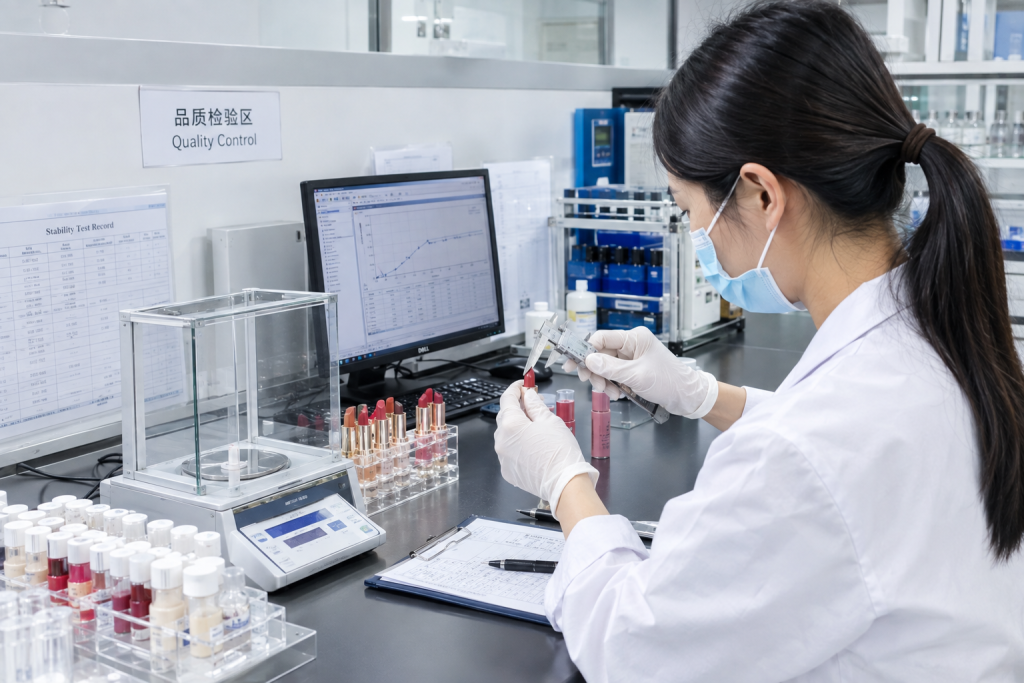
For foundation, for example, the review may include coverage, finish, shade accuracy, oxidation, texture and packaging compatibility.
Record every sample revision and approval.
Step 5: Agree on testing and quality requirements
The appropriate testing programme depends on the product, formula, packaging and destination market.
It may involve stability, microbiological, physicochemical or packaging compatibility evaluation. Agree on the scope, responsibility and acceptance criteria before bulk production.
Do not treat a sample approval as a substitute for any additional testing required for the finished product.
Step 6: Approve a controlled first production run
Where commercially practical, use the first order to verify that the new manufacturing process can meet the approved requirements.
Inspect the finished product, packaging, labels and agreed documentation. Compare the result with the signed-off reference sample.
Only increase order volumes after the relevant production and quality requirements have been met.
Step 7: Protect inventory during the transition
Calculate current stock, sales velocity, outstanding purchase orders and the time needed for sampling and production with the new supplier.
A staged transition may be safer than moving every SKU at once. Some brands continue their existing production temporarily while the new manufacturer completes technical evaluation and approval.
The right approach depends on stock levels, contractual commitments and the urgency of the original problem.
How to Evaluate a New Manufacturing Partner
The next supplier should address the weaknesses that caused the previous relationship to fail.
Use a consistent evaluation framework for every candidate. This makes it easier to compare proposals objectively.
Previous problem
What the next supplier must demonstrate
Inconsistent quality
Documented specifications and batch controls
Repeated delays
Realistic scheduling and progress updates
Poor communication
Clear project contacts and responsibilities
Formula variation
Technical review and controlled sample approval
Unclear costs
Complete, itemised quotations
Limited development
Relevant formulation and sampling capabilities
Missing records
Clear documentation and traceability procedures
Limited capacity
Evidence of suitability for planned order volumes
Do not rely entirely on a sales presentation. Ask for relevant documentation, inspect samples and clarify which processes are performed at the proposed manufacturing site.
For brands that are seriously evaluating a new factory in China, an in-person or virtual visit can help verify the production environment and discuss technical requirements directly. Our cosmetics factory visit guide explains what buyers can review during a visit.
You can also use our 15-question manufacturing partner approval checklist to organise your supplier evaluation.
Discussing a New Manufacturing Project with Guangzhou Cindi Cosmetics
For brands considering changing cosmetics suppliers, the first discussion should focus on the products and the manufacturing requirements, not simply on replacing one quotation with another.
Guangzhou Cindi Cosmetics Co., Ltd. is based in Baiyun District, Guangzhou, China, and works with brands on OEM, ODM and private label cosmetics projects.
Depending on the product and project requirements, an initial discussion can cover makeup and skincare categories, formula requirements, packaging, sampling, target quantities and production arrangements.
For an existing product transfer, useful information includes:
Product category and current specifications.
Approved reference samples.
Formula information that your brand is entitled to share.
Packaging requirements and artwork.
Target quantity and expected repeat-order schedule.
Target sales markets.
Any known quality or production issues.
This information allows the team to assess the project and identify which requirements need further technical review.
If you are considering a new product range as well as a supplier change, you can explore our OEM cosmetics manufacturing services.
To discuss a potential project, use the Cindi cosmetics manufacturing enquiry page. Sharing a clear product brief is the most useful starting point for an initial evaluation.
Frequently Asked Questions
Important answers for established beauty brands evaluating a new cosmetics manufacturing partner.
01 When should a beauty brand consider changing cosmetics suppliers?
Consider a change when recurring problems affect quality, delivery, communication, development or commercial requirements and the existing supplier cannot resolve them through an agreed improvement process.
02 Can a new manufacturer reproduce an existing cosmetic formula?
Possibly, but it requires technical evaluation. The new supplier needs sufficient formula information, reference samples and the legal right to use the relevant intellectual property. Raw material and process differences may require adjustments.
03 Will changing suppliers affect product quality?
It can, particularly if the transfer is rushed. Use approved reference samples, written specifications, sample revisions and appropriate testing to evaluate the new production process before placing larger orders.
04 How long does a supplier transition take?
There is no universal timeline. Standard products with complete specifications may transfer more quickly than products requiring formula redevelopment, custom packaging or additional testing. Confirm a realistic schedule with the new supplier.
05 Can I keep my existing packaging when moving to another factory?
Sometimes. The new manufacturer should check dimensions, materials, filling requirements, assembly and compatibility with the formula. Also confirm who owns the packaging artwork, moulds and tooling.
06 Should I move all my products to a new supplier at once?
Not necessarily. A staged transfer can reduce risk for brands with multiple SKUs. Start with products that have complete specifications or urgent supply issues, then assess the new supplier's performance before transferring the remaining range.
07 What information should I provide when requesting a quotation?
Provide the product category, target quantity, net content, formula or performance requirements, packaging details, shade requirements and target market. Existing samples and product specifications are particularly useful.
08 Should I choose a direct factory or a trading company?
It depends on the level of manufacturing visibility, technical support and coordination your business needs. Evaluate the actual manufacturing arrangements, responsibilities and communication process rather than relying only on the supplier's business description.
09 Do I need to repeat product testing when changing manufacturers?
Not every test must automatically be repeated, but a change in formula, raw materials, process, packaging or manufacturing site may affect the appropriate testing programme. Discuss the requirements with qualified technical and regulatory specialists.
10 How can I reduce the risk of changing manufacturing partners?
Review contractual rights, prepare complete product files, evaluate multiple candidates, approve samples, agree on quality requirements and plan inventory carefully. Avoid moving to bulk production before the new supplier has demonstrated that it can meet the agreed specifications.
Ready to Evaluate a New Manufacturing Partner?
Share your product category, specifications and target quantity with our team to begin a practical manufacturing discussion.