Cosmetics Factory vs Trading Company: Understanding the Two Business Models
When searching for a reliable cosmetics factory in China, international beauty brands often face an important decision: should they work directly with a cosmetics manufacturer or choose a trading company? Although both types of suppliers may offer product catalogues, quotations, samples and packaging solutions, their roles in the manufacturing process can be very different.
Choosing the right supplier can directly affect your product quality, development costs, production schedule and long-term business growth. A direct cosmetics factory may provide closer access to formula development, production management and quality control, while a trading company may offer more flexible sourcing services and help coordinate products from multiple manufacturers.
Before making a decision, buyers should understand the key differences between a cosmetics factory and a trading company in China. This guide compares nine important factors, including pricing, MOQ, OEM/ODM customisation, quality management, communication and factory verification, helping you identify the right manufacturing partner for your beauty brand.
1. What Is the Difference Between a Cosmetics Factory and a Trading Company?
The basic distinction is straightforward: a cosmetics factory manufactures products, while a trading company sources products from manufacturers and resells them to customers.
The practical arrangements can be more complicated, particularly in China’s cosmetics supply chain. Some factories have separate export departments or related trading entities. Some trading companies work closely with a small group of factories. Others source different product categories from multiple manufacturers.
For this reason, buyers should not rely only on a supplier’s website, company name or sales description. They should establish which legal entity is responsible for manufacturing and where the actual production takes place.
What does a cosmetics factory do?
A cosmetics manufacturer is directly involved in making products. Depending on its capabilities and business model, its operations may include:
Raw material sourcing and inspection.
Formula selection and development.
Ingredient weighing and batching.
Mixing, emulsifying or powder processing.
Filling, pressing and assembly.
Packaging and labelling.
In-process quality control.
Finished-product inspection.
Production documentation and batch traceability.
Not every factory performs every operation in-house. Certain packaging components, specialised processes or testing services may be outsourced. The important point is that the manufacturer should clearly explain which activities it controls and which are handled by approved external partners.
A genuine cosmetics manufacturer should be able to explain its production processes in technical terms and provide appropriate evidence of its manufacturing operations.
What does a cosmetics trading company do?
A trading company normally purchases products from manufacturers and sells them to overseas customers.
Its responsibilities may include:
Finding suitable factories.
Collecting product quotations.
Coordinating samples.
Communicating customer requirements.
Arranging packaging and labelling.
Managing purchase orders.
Coordinating inspections.
Preparing export documentation.
Organising shipping and delivery.
A good trading company can provide meaningful value, particularly when a buyer needs to source many different product categories from several manufacturers.
However, the trading company may not directly control the production equipment, formulation decisions or factory production schedule. Those responsibilities remain with the actual manufacturer.
Quick comparison
Business area
Cosmetics factory
Trading company
Main role
Manufactures products
Sources and resells products
Production equipment
Operates or controls production equipment
Usually relies on partner factories
Formula development
May have its own R&D capability
Usually coordinates with manufacturers
Product range
Often focused on particular categories
Can offer products from many categories
Pricing
Quotes based on its manufacturing and commercial costs
May include supplier cost plus a service margin
MOQ
Depends on equipment, materials and production economics
May offer flexible quantities through multiple suppliers
Quality control
Can directly manage manufacturing-stage checks
Depends on factory access and inspection arrangements
Customisation
Can directly manage customisation within its capabilities
Coordinates customisation with production partners
Factory visits
Can arrange access to its production site
May arrange visits to partner factories
Export services
Depends on its export capabilities
Often a core service
These are general differences, not universal rules. A factory may have a limited product range, while a specialist trading company may manage a sophisticated supplier network. The buyer should evaluate the actual operating model rather than assume that one label guarantees better performance.
2. Pricing: Is Buying Directly from a Cosmetics Factory Always Cheaper?
Price is one of the first reasons international buyers compare manufacturers and trading companies.
A trading company may purchase products from a factory and add a commercial margin before selling them to the buyer. This means a direct manufacturer quotation can sometimes be more competitive.
However, the lowest quoted unit price does not necessarily represent the lowest total purchasing cost.
A fair comparison needs to consider what is included in each quotation.
How factory-direct pricing works
A cosmetics factory generally calculates its quotation using several cost components:
Formula and raw material costs.
Packaging components.
Filling, pressing and assembly.
Labour and production expenses.
Quality inspection.
Packaging and labelling.
Manufacturing overhead.
Export-related costs, where applicable.
Commercial margin.
For customised cosmetics, the formula and packaging can have a significant influence on the final price.
For example, two lip gloss products may look similar in a product catalogue but have different costs because of their formula, applicator, bottle material, decoration, filling volume and packaging requirements.
A factory with direct control over the relevant production processes may be able to explain these cost differences more clearly.
Working directly with a cosmetics factory can give buyers a clearer understanding of manufacturing costs. Instead of receiving only a final resale quotation, brands can discuss formula costs, packaging expenses, production requirements and customisation options directly with the manufacturer. This makes it easier to understand how different product specifications affect the final unit price and identify potential ways to optimise the production budget.
How trading company pricing works
A trading company may obtain a quotation from one or more factories and provide the buyer with a consolidated price.
Its commercial margin may cover services such as:
Supplier selection.
Communication and project coordination.
Sample collection.
Order consolidation.
Export administration.
Quality inspection.
Logistics coordination.
The margin is not automatically an unnecessary cost. It may represent services that the buyer would otherwise need to organise independently.
The important question is whether those services create enough value to justify the additional cost.
Compare the total landed cost, not only the unit price
Consider two quotations for the same customised cosmetic product.
Business area
Cosmetics factory
Trading company
Unit price
Lower
Higher
Formula development
Quoted separately
Included
Packaging
Not fully specified
Included
Quality inspection
Additional cost
Included
Export documentation
Buyer arranges
Supplier coordinates
Production site
Not disclosed
Identified
Rework responsibility
Unclear
Defined in agreement
Supplier A may initially appear cheaper, but the final cost could change once the missing services are added.
When comparing a cosmetics manufacturer in China with a trading company, ask both suppliers to quote against the same product specifications, packaging requirements, quantity, delivery terms and documentation requirements.
A useful rule: Compare quotations on an equivalent basis. A lower price is meaningful only when the products, specifications, responsibilities and delivery conditions are comparable.
3. MOQ: Which Supplier Offers More Flexible Order Quantities?
Minimum order quantity is another important consideration, especially for new beauty brands and companies testing a new product line.
There is a common assumption that factories always require large orders and trading companies always accept small quantities. This is not necessarily true.
MOQ depends on the product, formula, packaging supplier, production equipment, material purchasing requirements and the manufacturer’s order policy.
Why cosmetics factories set MOQs
A factory needs to organise production efficiently.
For example, a customised foundation may require:
Formula preparation.
Shade development.
Pigment dispersion.
Bulk material production.
Bottle and pump sourcing.
Filling and assembly.
Label and carton printing.
Each stage may have a different minimum quantity.
A factory may accept a relatively small production order for a standard formula and existing packaging but require a higher quantity for a fully customised product.
Custom packaging can also have its own MOQ. A special bottle, unique cap, printed component or newly developed mould may require a separate purchasing commitment.
Why trading companies may offer smaller orders
Trading companies sometimes purchase products from existing factories and combine different products into one customer order.
This can help buyers who need:
Several product categories.
Small quantities of standard products.
Mixed packaging options.
Products from different manufacturing locations.
Consolidated shipping.
However, a small order does not always mean a lower total cost. The supplier may charge more per unit or apply additional handling and coordination fees.
Questions to ask about MOQ
Before choosing a supplier, ask:
Is the MOQ calculated per product or per shade?
Can the order quantity be divided across different colours?
Does the packaging have a separate MOQ?
Is the formula already available or does it require custom development?
Are sample and tooling fees separate from the bulk order?
Can the supplier support repeat orders with the same specifications?
For an established brand, MOQ should be evaluated together with production consistency and the ability to scale.
For a new brand, it is worth asking whether the manufacturer can offer an existing formula or standard packaging option to reduce the initial development burden.
The best supplier is not necessarily the one with the lowest MOQ. It is the one whose production model matches your launch plan and future order requirements.
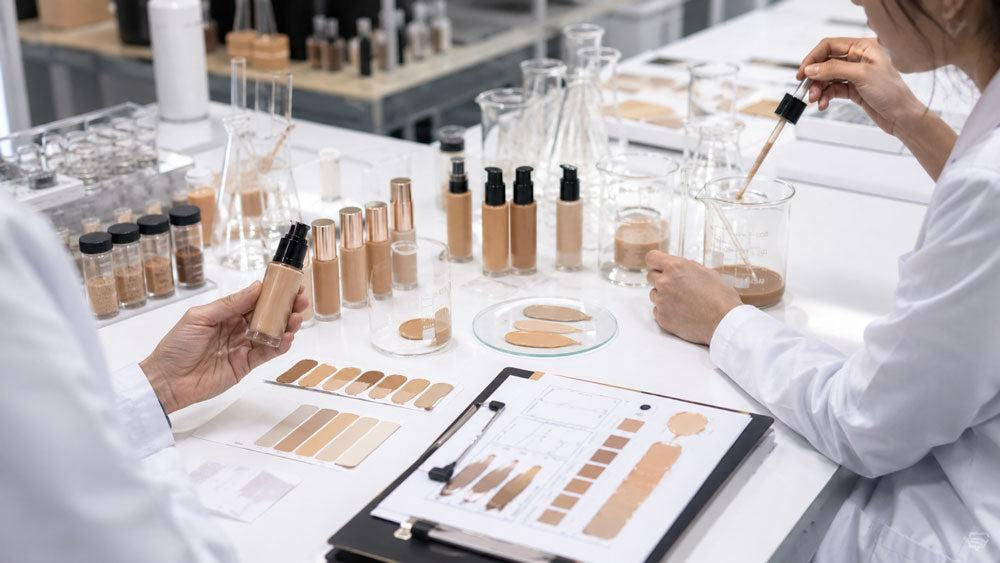
4. OEM and ODM Customisation: Who Has Better Control Over Product Development?
This is one of the most important differences for beauty brands that want to build a distinctive product range.
Cosmetics development involves much more than choosing a bottle and adding a logo. Product performance, texture, shade, formula stability, packaging compatibility and manufacturing repeatability all matter.
A manufacturer with genuine technical capabilities may be able to work directly with your development team to turn a product brief into a production-ready formula.
A trading company can also coordinate custom development, but it normally relies on an external factory for technical decisions and manufacturing execution.
Working directly with a cosmetics manufacturer’s R&D team
Depending on the manufacturer’s capabilities, direct cooperation may allow the buyer to discuss:
Formula texture and viscosity.
Coverage and finish.
Pigment concentration.
Shade matching.
Ingredient preferences.
Fragrance requirements.
Product stability.
Packaging compatibility.
Performance expectations.
Manufacturing feasibility.
For example, a brand developing a new foundation may need more than a colour match.
It may require a specific coverage level, skin finish, oxidation profile, application feel and compatibility with a particular bottle and pump.
These requirements need technical evaluation. Direct access to the people responsible for formulation and production can make discussions more efficient.
A professional cosmetics factory should be able to explain which product development services it provides directly and which processes involve external partners. This distinction helps buyers evaluate whether the manufacturer has the technical capabilities and production resources to support their long-term product development plans. It also makes responsibilities clearer when a project involves specialised formulation, packaging engineering or third-party testing.
OEM vs ODM
The two common manufacturing models are OEM and ODM.
OEM — Original Equipment Manufacturing
The buyer provides a detailed product brief, specifications or an existing formula, and the manufacturer produces the product according to the agreed requirements. Depending on the agreement, the manufacturer may also develop a customised formula.
ODM — Original Design Manufacturing
The buyer selects an existing formula or product concept offered by the manufacturer and customises elements such as branding, packaging, shades or other available specifications.
Requirement
OEM
ODM
Formula
Customised or buyer-specified
Selected from available formulas
Development
Usually more involved
Often faster
Product differentiation
Greater potential
Depends on available customisation
Development cost
May be higher
Often lower
Best suited to
Brands with specific product requirements
Brands seeking a faster launch
The exact formula ownership, exclusivity and permitted reuse arrangements should always be documented in the manufacturing agreement.
Can a trading company support OEM or ODM projects?
Yes. Some trading companies work with established manufacturing partners and can coordinate custom development.
The buyer should ask:
Who is responsible for the formula?
Which company performs the development?
Can the buyer communicate with the technical team?
Where will the product be manufactured?
Who approves formula changes?
Who is responsible if the final bulk product differs from the approved sample?
What happens if the manufacturing factory changes?
For a simple standard product, this arrangement may be perfectly practical.
For a proprietary formula, complex packaging or a long-term product programme, direct visibility into the manufacturing process becomes more important.
If your brand needs customised formulations, review the manufacturer’s actual cosmetic product development capabilities before making a decision.
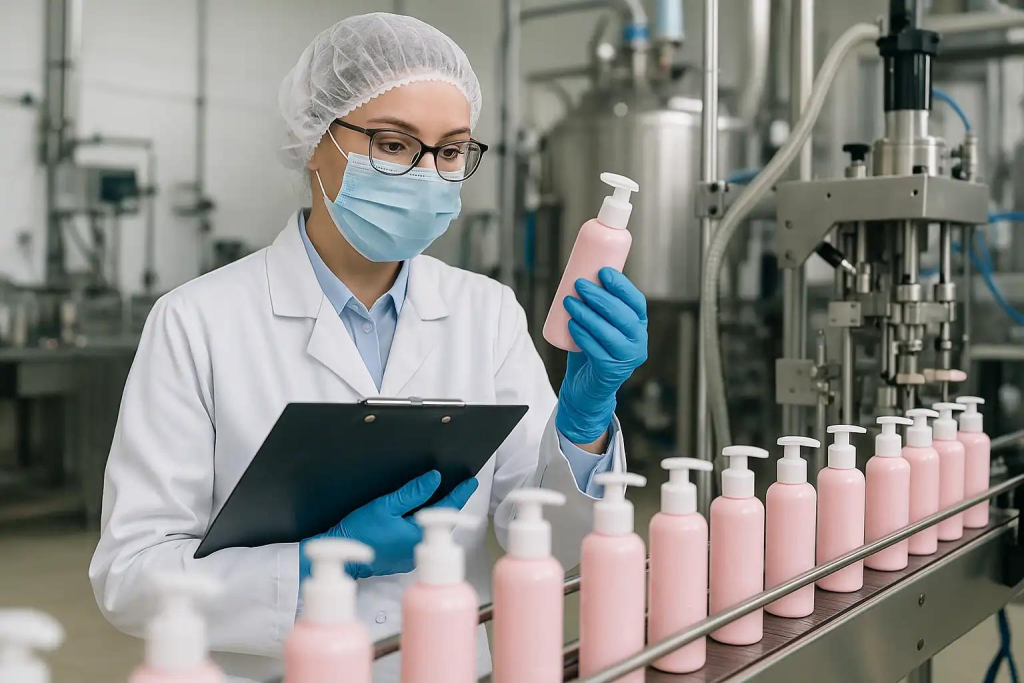
5. Quality Control: Who Is Responsible When Something Goes Wrong?
Quality control is not simply a final inspection before shipping.
For cosmetics, quality management should cover the manufacturing process from incoming raw materials to finished-product release.
A product may look correct in a photograph but still have problems with texture, colour consistency, filling quantity, packaging compatibility, leakage or stability.
The buyer needs to understand who controls each stage and who is contractually responsible for resolving non-conformities.
Quality control inside a cosmetics factory
A manufacturer may conduct quality checks at several stages.
Incoming material inspection
Raw materials and packaging components should be checked against the approved specifications and purchasing requirements.
Production monitoring
The manufacturer monitors relevant production parameters, such as mixing conditions, filling quantities, processing temperatures or other product-specific controls.
In-process inspection
Checks may include colour, texture, appearance, weight, assembly and packaging performance.
Finished-product inspection
Finished products are checked against agreed specifications and acceptance criteria before release.
Documentation and traceability
Depending on the product and quality system, records may include batch information, inspection results, raw material records and certificates of analysis.
What happens when a trading company manages quality?
A trading company may have its own quality inspection team or hire a third-party inspection provider.
It may also rely on the manufacturing factory’s internal QC department.
This arrangement can work well, provided that inspection responsibilities, acceptance standards and corrective-action procedures are clearly defined.
The buyer should not assume that a trading company has direct control over every manufacturing-stage decision.
Why ISO 22716 matters
ISO 22716 is an international standard providing Good Manufacturing Practice guidelines for cosmetics.
Its scope covers quality aspects of cosmetic production, control, storage and shipment.
However, buyers should understand what the standard does and does not establish. An ISO 22716 certificate is not a guarantee that every individual product is suitable for every market, nor does it replace product-specific safety assessments, regulatory responsibilities or independent verification.
When evaluating a supplier, request the relevant certificate and check:
The legal entity named on the certificate.
The manufacturing site covered.
The scope of certification.
The issuing certification body.
The certificate’s validity.
Whether the actual production site matches the site being audited.
For a more detailed explanation of manufacturing quality systems, see Cindi’s cosmetics quality management information.
6. Communication and Accountability: Who Actually Makes the Decisions?
Communication can determine how smoothly a customised cosmetics project progresses.
A buyer may need to discuss a formula adjustment, packaging change, production delay, shade correction or quality issue. These conversations often require technical information from the people directly involved in manufacturing.
Communication with a factory
When working directly with a manufacturer, the buyer may be able to communicate with:
Sales or project managers.
Product development staff.
R&D chemists.
Packaging coordinators.
Production managers.
Quality control personnel.
This can reduce the number of communication steps between the buyer and the people responsible for the product.
However, direct factory communication is not automatically better. Some manufacturers have limited export experience or may not provide sufficient English-language support.
A capable manufacturer should combine technical knowledge with clear project communication.
Communication with a trading company
A trading company may offer an experienced international sales team and a more convenient customer service experience.
For buyers who do not speak Chinese, this can be a significant advantage.
The challenge arises when technical questions need to pass through several people:
Buyer → Trading company → Factory sales team → Production department → Trading company → Buyer.
This does not always cause problems, but it can introduce delays or misunderstandings if product specifications are not documented properly.
How to evaluate communication quality
Before placing an order, send the supplier a detailed product brief and observe how it responds.
A reliable supplier should be able to:
Identify missing technical information.
Explain which specifications are achievable.
Ask relevant questions about the target market.
Clarify packaging and formula limitations.
Explain sample and production stages.
Confirm who approves changes.
Provide written answers to important technical questions.
Do not evaluate a supplier only by how quickly it replies to WhatsApp messages.
Evaluate whether its answers are accurate, consistent and supported by the people responsible for the project.
7. Factory Verification: How Can You Tell Whether a Chinese Supplier Is a Real Manufacturer?
This is one of the most important steps in China sourcing.
A company website may use the words “factory”, “manufacturer”, “OEM” or “ODM”. Its product catalogue may contain hundreds of cosmetic items. It may even display photographs of production equipment.
None of these details alone proves that the company manufactures the products itself.
A proper supplier assessment should combine business registration checks, production evidence, documentation and direct communication.
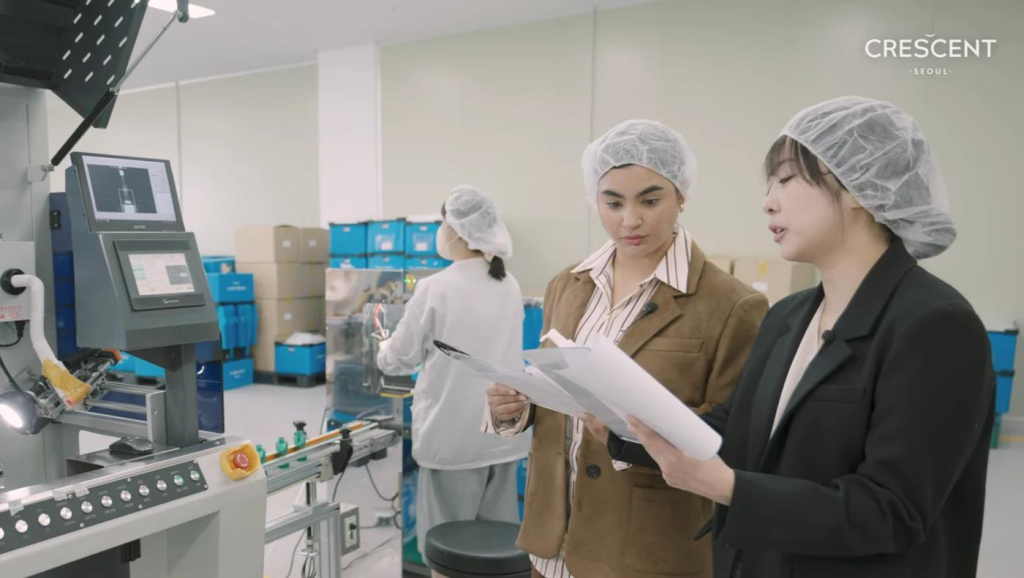
When evaluating a cosmetics factory in China, buyers should inspect the actual production site rather than relying entirely on a supplier’s catalogue or website. Confirming the manufacturing location is an essential step before approving samples or placing a bulk order. A factory visit or live video inspection can help buyers understand the production environment, equipment and manufacturing arrangements behind the products they intend to purchase.
Check the Chinese business licence
Ask the supplier for its Chinese business licence.
Review the registered company name, Unified Social Credit Code, registered address and business scope.
You can use China’s National Enterprise Credit Information Publicity System to search for public company registration information.
Look for business-scope wording related to manufacturing, production or processing, where applicable.
However, business scope alone is not conclusive evidence that a particular product is manufactured at the company’s premises. It should be considered alongside other evidence.
Request a live factory video tour
A live video call is more useful than a collection of promotional photographs.
Ask the supplier to show relevant areas, such as:
Raw material storage.
Production equipment.
Mixing and processing areas.
Filling or pressing equipment.
Packaging and assembly lines.
Quality inspection areas.
Finished-product storage.
For cosmetics, ask to see equipment relevant to your product category.
A supplier producing liquid foundation may have different equipment from one specialising in pressed powders or lip products.
The objective is not to see every machine in the building. It is to establish whether the production facilities and technical capabilities are consistent with the products being offered.
Ask who actually manufactures your product
Use direct questions:
Will this product be manufactured at your own facility?
Which legal entity operates the production site?
Can I visit the actual production location?
Do you outsource any manufacturing stages?
Who performs formula development?
Who is responsible for batch quality control?
Can the approved manufacturing site be identified in the contract?
A manufacturer may legitimately outsource certain components or specialised processes. What matters is whether those arrangements are disclosed and properly controlled.
Verify the production site and contract entity
The company receiving payment, the company signing the contract and the company manufacturing the product may not always be the same legal entity.
This can occur when a manufacturer uses a related export company or a separate trading entity.
Such an arrangement is not automatically a problem, but the relationship must be clear.
Before paying a deposit, establish:
Which company signs the agreement.
Which company receives the payment.
Which factory produces the goods.
Which company issues relevant invoices and documents.
Which party is responsible for product quality and corrective action.
The audit should cover the actual production site, and the contract should identify the relevant responsibilities.
Look beyond certificates
Certificates can be useful evidence, but they should be checked carefully.
Ask for the original documents or verifiable copies. Confirm that the named company, site and scope match the supplier’s claims.
Do not accept a certificate belonging to a different company or unrelated manufacturing location as proof of the supplier’s own capabilities.
8. When Should You Choose a Cosmetics Factory Instead of a Trading Company?
The best sourcing model depends on your business situation.
A direct manufacturer is often a strong choice when the project requires technical development, production consistency or a long-term manufacturing relationship.
A trading company can be a better fit when the buyer values supplier coordination, mixed-product sourcing or a single export contact more than direct production access.
Scenario A: You are an established beauty brand changing manufacturers
If your brand already has approved products and wants to move production to a new supplier, direct manufacturer access can be valuable.
You may need to discuss:
Existing formula specifications.
Reference samples.
Ingredient restrictions.
Shade standards.
Packaging drawings.
Production tolerances.
Stability and compatibility requirements.
Quality acceptance criteria.
A manufacturer can assess whether the existing product can be reproduced, adapted or transferred.
However, formula transfer should never be assumed to be automatic. The original formula, raw material specifications, processing methods and intellectual property rights all need technical review.
Recommended approach: Shortlist verified manufacturers with relevant product experience and evaluate their ability to reproduce your approved specifications.
Scenario B: You are launching a new private label cosmetics brand
A new brand may need help with formula selection, packaging, product design and sampling.
A manufacturer offering ODM or private label services can provide a more direct route to product development.
The buyer should compare:
Available formulas.
Customisation options.
Packaging choices.
Sample fees.
MOQ.
Production timelines.
Documentation support.
A trading company can also coordinate these services, but the actual manufacturer and its responsibilities should be identified before development begins.
Recommended approach: Choose a supplier with a clear development process and transparent access to the manufacturing partner.
Scenario C: You need several different product categories
Suppose you want to purchase makeup brushes, skincare bottles, cosmetic bags, lip products and packaging components from different suppliers.
A trading company or sourcing partner may be more convenient because it can coordinate several factories and consolidate shipments.
A single cosmetics factory may not manufacture every item in your list.
Recommended approach: Consider a trading company if supplier consolidation is more important than direct manufacturing control for each product.
Scenario D: You need custom formulas and packaging
If your project requires a distinctive formula, special shades, customised packaging or new moulds, direct access to the relevant technical teams becomes especially important.
You need to know who controls:
Formula development.
Packaging engineering.
Mould production.
Sample revisions.
Production approval.
Quality standards.
Recommended approach: Work with a verified manufacturer that can demonstrate the relevant capabilities. If external partners are involved, identify them and define their responsibilities.
Scenario E: You are planning long-term repeat orders
For a brand expecting to reorder products regularly, manufacturing consistency becomes a major commercial consideration.
A long-term supplier relationship should include:
Approved product specifications.
Consistent raw material requirements.
Batch records.
Agreed quality standards.
Change-control procedures.
Production planning.
Clear responsibility for defects.
A process for managing future formula or packaging changes.
Recommended approach: Prioritise a manufacturer with relevant prod
9. Questions to Ask Before Choosing a Cosmetics Supplier in China
Before sending a deposit or approving bulk production, ask the following questions.
Manufacturing and facility
Are you the actual manufacturer or a trading company?
Where will my products be manufactured?
Can I visit the production facility?
Can you arrange a live video factory tour?
Which manufacturing stages are outsourced?
Formula and product development
Do you have an in-house R&D team?
Can you develop a formula based on my specifications?
Can you reproduce an existing product sample?
Who owns the formula after development?
Can I review and approve samples before bulk production?
Packaging and customisation
Can you source or customise packaging?
Can I provide my own packaging design?
Are there separate MOQs for packaging?
Who owns the moulds and tooling?
What happens if I change manufacturers in the future?
Quality and compliance
What quality management system do you follow?
Can you provide relevant certificates?
What testing is performed before production approval?
Can you provide COA and other agreed product documentation?
How do you handle products that fail inspection?
Commercial and delivery
What is the MOQ per product and per shade?
Are sample and development fees separate?
What is the estimated production lead time?
Which company signs the contract and receives payment?
What are the agreed shipping and delivery terms?
A supplier that answers these questions clearly is easier to evaluate than one that relies on general promises such as “best quality”, “factory price” or “fast delivery”.
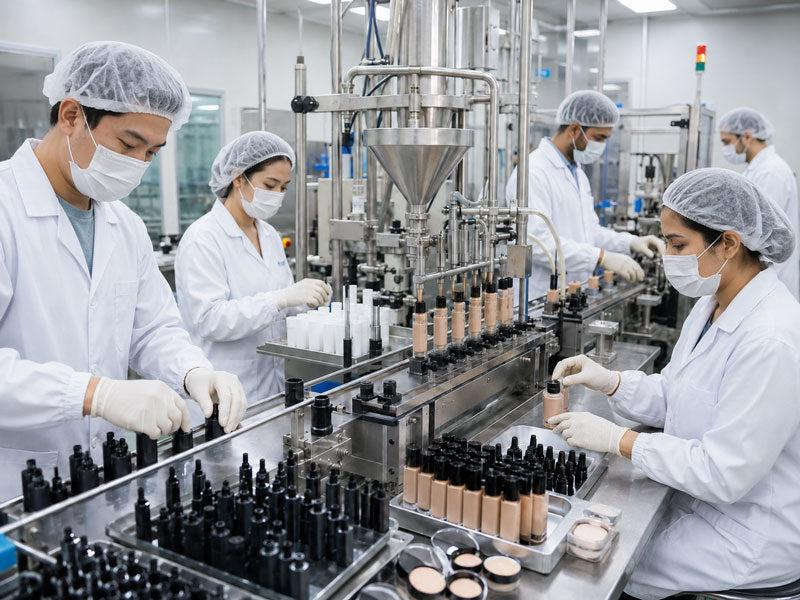
Factory vs Trading Company: Which Is the Better Choice?
There is no universal answer. The right supplier depends on the requirements of your project.
Your business requirement
Supplier model to consider
Custom formula development
Verified cosmetics manufacturer
Long-term production partnership
Verified cosmetics manufacturer
Existing formula reproduction
Manufacturer with relevant product experience
Custom packaging and mould development
Manufacturer with relevant technical control
Small mixed orders across many categories
Trading company or sourcing partner
Consolidated purchasing from several factories
Trading company or sourcing partner
Direct access to production and QC
Verified manufacturer
International sourcing coordination
Experienced trading company or sourcing partner
The most important distinction is not whether a supplier calls itself a factory or a trading company.
It is whether the supplier is transparent about its role, can demonstrate the capabilities it promises, and accepts clear responsibility for the work it undertakes.
A professional trading company can be a useful business partner. A verified cosmetics manufacturer can offer direct access to product development and production. Both can serve international buyers effectively when their roles are understood and documented.
Why Work Directly with Guangzhou Cindi Cosmetics?
For beauty brands that want to develop, customise or manufacture their own cosmetic products in China, working directly with a manufacturer can make the production relationship easier to understand.
Guangzhou Cindi Cosmetics Co., Ltd. is an OEM/ODM cosmetics manufacturer based in Baiyun District, Guangzhou, China.
Cindi works with brands seeking customised makeup and private label cosmetics, including projects involving formula selection, product development, packaging coordination, sampling and manufacturing.
The company’s manufacturing services are designed to support different stages of brand development:
OEM and custom product development
For brands with specific product requirements, the development process can begin with a product brief covering the desired texture, shade, finish, ingredients and performance.
The R&D team evaluates the requirements and works on a suitable formulation and sample for review.
ODM and private label manufacturing
For brands that want to launch products using available formulations, ODM and private label services provide an alternative to developing every formula from the beginning.
Buyers can discuss available product options, packaging and branding requirements before confirming the project.
Packaging customisation
Packaging is an important part of product identity.
Cindi supports packaging selection and customisation, allowing brands to discuss bottle, tube, jar, palette and other packaging requirements as part of their product development process.
Manufacturing and quality management
Cindi’s manufacturing process includes production and quality management activities. Buyers can discuss the relevant product specifications, sampling requirements and quality documentation with the team before confirming an order.
For more information, explore the company’s contract manufacturing services and quality management approach.
Arrange a factory visit
If you are planning to visit Guangzhou, a factory visit can help you understand the manufacturing environment, discuss your product requirements and evaluate whether the supplier is suitable for your project.
You can learn more about arranging a Cindi cosmetics factory visit before travelling.
The best way to evaluate a manufacturing partner is to discuss your actual products, review the relevant capabilities and verify the production arrangements before making a decision.
Looking for a cosmetics manufacturing partner in China? Share your product category, target market, estimated order quantity and packaging requirements with Cindi. The team can review your project and discuss suitable OEM, ODM or private label options.
Contact Guangzhou Cindi Cosmetics to discuss your next cosmetics project.
Frequently Asked Questions
Everything you need to know before choosing a cosmetics manufacturing partner in China.
01 Is a cosmetics factory better than a trading company in China?
Not in every situation. A factory may provide more direct access to production, formulation and quality control. A trading company may be more convenient for small mixed orders, supplier consolidation and export coordination. The right choice depends on your product requirements and sourcing priorities.
02 How can I verify whether a Chinese cosmetics supplier is a real factory?
Start by checking its Chinese business licence and registered business scope. Then request a live factory tour, inspect relevant production equipment, review manufacturing documents and confirm the actual production location. No single document or photograph should be treated as conclusive proof.
03 Do trading companies always charge higher prices?
Not necessarily in terms of total purchasing cost. A trading company may include a margin, but it can also provide supplier coordination, inspection, consolidation and export services. Compare the full quotation and service scope rather than looking only at the unit price.
04 Can a trading company provide OEM and ODM cosmetics?
Yes. A trading company can coordinate OEM or ODM projects through manufacturing partners. Buyers should identify the actual factory, understand who controls formulation and production, and document the responsibilities of each party.
05 Can I visit a cosmetics factory in China before placing an order?
Many manufacturers can arrange visits for prospective buyers, subject to scheduling and facility access. Before visiting, confirm the company's legal name, factory address and whether the production site you will see is the one intended to manufacture your products.
06 What documents should I request from a cosmetics manufacturer?
Depending on your project and target market, you may request a business licence, relevant manufacturing or quality certificates, product specifications, ingredient information, COA, MSDS/SDS, testing reports and other regulatory documents. Requirements vary by product and destination market.
07 Is ISO 22716 certification enough to prove a cosmetics factory is reliable?
No. ISO 22716 provides Good Manufacturing Practice guidelines for cosmetics production, control, storage and shipment. It is one part of supplier evaluation. Buyers should also assess production capability, product-specific testing, traceability, documentation and actual manufacturing performance.
08 Should established beauty brands work directly with manufacturers?
Direct manufacturing relationships can be particularly useful for established brands that require repeat production, customised formulas, packaging development and consistent product specifications. However, the manufacturer should be assessed against the brand's technical and commercial requirements before a partnership begins.
09 What should I check before paying a cosmetics supplier in China?
Confirm the legal contracting entity, bank beneficiary, manufacturing location, approved product specifications, sample approval, payment terms, production timeline, inspection arrangements and responsibility for non-conforming goods. Make sure the contract reflects the actual supply-chain arrangement.
10 Can I change from a trading company to a direct cosmetics manufacturer?
Yes, but the transition needs planning. Review your existing formula rights, product specifications, packaging drawings, mould ownership, approved samples and regulatory documentation. The new manufacturer should assess whether the product can be reproduced and what additional development or testing may be required.
Still have questions about your manufacturing project?
Talk to our team ↗Final Thoughts
Choosing between a cosmetics factory and a trading company in China is ultimately a decision about control, service and responsibility.
A trading company can simplify sourcing when you need multiple products or suppliers. A verified manufacturer can provide more direct access to the people and processes responsible for making your cosmetics.
For brands investing in customised formulas, distinctive packaging and long-term product lines, understanding the actual manufacturing relationship is especially important.
Do not choose a supplier based on a website description or the lowest quotation alone. Verify the company, understand the production arrangement, review the quality system and put responsibilities in writing.
A reliable sourcing decision starts with knowing exactly who will make your products.
Finding a reliable cosmetics factory requires more than comparing quotations. Buyers should evaluate manufacturing capabilities, quality management, communication, product development and long-term production consistency before choosing a supplier. Taking time to verify these factors can help reduce sourcing risks and build a more dependable manufacturing partnership.
Ready to discuss your cosmetics project? Contact Guangzhou Cindi Cosmetics to explore OEM, ODM and private label manufacturing options in China.